Sunday, June 23, 2024

Vivian Maier: Unseen Work

Self Portrait, New York, NY, 1953

This week I visited Fotografiska to see Vivian Maier: Unseen Work.

I’ve made one previous post about this special artist, comparing my own work to hers and reflecting on the myriad inspirations that arise when I spend time with her photographs. I rarely feel emboldened to make pictures of people (in truth I feel more confident in doing so when abroad, perhaps because the language barrier provides a buffer), but again, after seeing the work on view, I’m considering trying my hand at candid portraiture in my own city.

That said, there is something in Maier’s photographs that I feel I won’t readily attain: character. The bulk of my work is centered on documenting what remains of past generations of this city amidst a depressing homogenization of buildings (see: oppressive glass boxes) and it’s uncommon to see well- or interestingly-dressed people out and about (see: athleisure). I’m not saying it can’t be done, but achieving the same quality Maier did in her portraiture might not be within the realm of possibility for a photographer of my predilection in a city this hyper-gentrified.

This was the second Maier exhibition I have had the pleasure of attending. The first was Vivian Maier: The Color Work at Howard Greenberg Gallery in November 2018. While she predominantly shot monochrome, Maier’s color work is exquisite. At Unseen Work, there were a select few color images, printed by the photographer, that have lost their luster to the ravages of time; these were not part of The Color Work show. I overheard a French woman, speaking to another attendee while viewing these images, remark that Maier’s work loses quality when in color. I had to stop and tell her about The Color Work, of which she was not aware, which lead to an interesting discussion about Maier and the difficulty of finding great photo exhibitions in New York City. I could only partially agree: I have seen some truly incredible gallery shows, exhibits, and retrospectives in my time here, but they do seem less frequent these days. Shieli, the woman with whom I was speaking, then told me that in Paris for the entire month of October, all of the art galleries have photography on view. Apparently this is a yearly tradition, and one that I am now eager to experience.

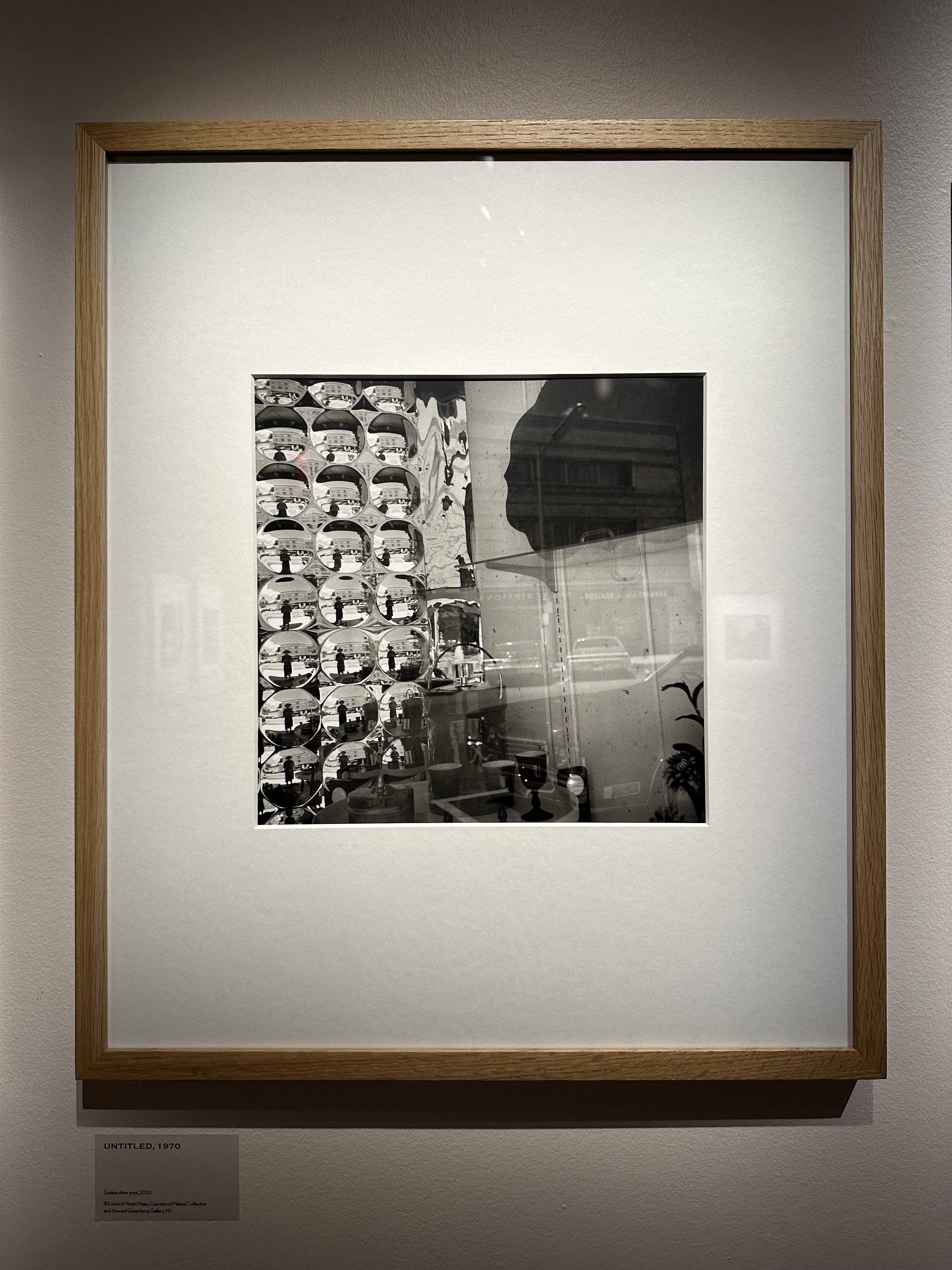
One of my favorite things about Maier's work is her framing. Whether it be self portraiture in various reflective surfaces or of other people going about their business, she was a master of finding interesting ways to frame her subjects. Below are a selection of images from the exhibition I found myself lingering over that had this quality.



Thursday, May 30, 2024

Shhh

I’ve become obsessed with silence.
Searching for it, reveling in it when I do manage to find it, and learning to appreciate the moments where my world is blissfully, totally quiet.

This may be a reaction from living in a very noisy city for nearly a decade, as well as the wisdom that comes from being in my mid-thirties and realizing being at peace is favorable to chaos. I prefer the tinnitus ringing brought forth by the use of ear plugs over the early morning cooing of sexually active pigeons in my airshaft. I prefer the relative stillness of my cozy apartment over the deafening roar of other humans and various vehicles I confront by stepping out the front door. Not to say I never leave, but to venture out takes more mental preparation these days. This fascination with quiet lead me to look for traces of it in the work of some of my favorite photographers. 

Stephen Shore’s cross-country road trip photos in Uncommon Places came to mind first; the calm, occasionally desolate vistas he captured in the mid-70’s always instill a sense of quiescence.

U.S. 97, South of Klamath Falls, Oregon, July 21, 1973

Bellevue, Alberta, August 21, 1974


Eugene Atget’s Paris work, taken in the early mornings of the late 19th and early 20th centuries, and almost totally devoid of other people, imply a silence one could only dream of now.

Église Saint-Médard, Paris, 1900

Boulevard de Bonne-Nouvelle, Paris, 1926


Duane Michals' Empty New York conveys similar, as he modeled his process for this work after Atget’s efforts across the pond. Taking to the streets before dawn during 1964-65, he captured a nearly unrecognizable city: empty, motionless, quiet. [I made a post about this work and Michals' ethos in 2018, it can be viewed here]

Untitled, New York, 1964-65


Untitled, New York, 1964-65


Francesca Woodman’s self portraits, while somber and sometimes haunting, are silent by design. Most of her work has this quality, but none more so than the typically untitled work created in the dilapidated Providence apartment she occupied as home and studio during her time at The Rhode Island School of Design in the mid-1970’s.

House #3, Providence, Rhode Island, 1976

House #4, Providence, Rhode Island, 1976

Thursday, February 29, 2024

Roaming Eight Years

I started this project on Leap Day 2016 because there is something quasi-poetic about a series regarding space and time having its anniversary on a day that feels like it’s outside of space and time.

The project has always been about memory, both mine and the collective memory of this city. I’ve been thinking about the way I learn, and repetition is one of the best ways for me to internalize new information and keep present not-so-recent findings. With that in mind, I made my roam today about revisiting places I’ve photographed before in the spirit of preservation and remembrance.

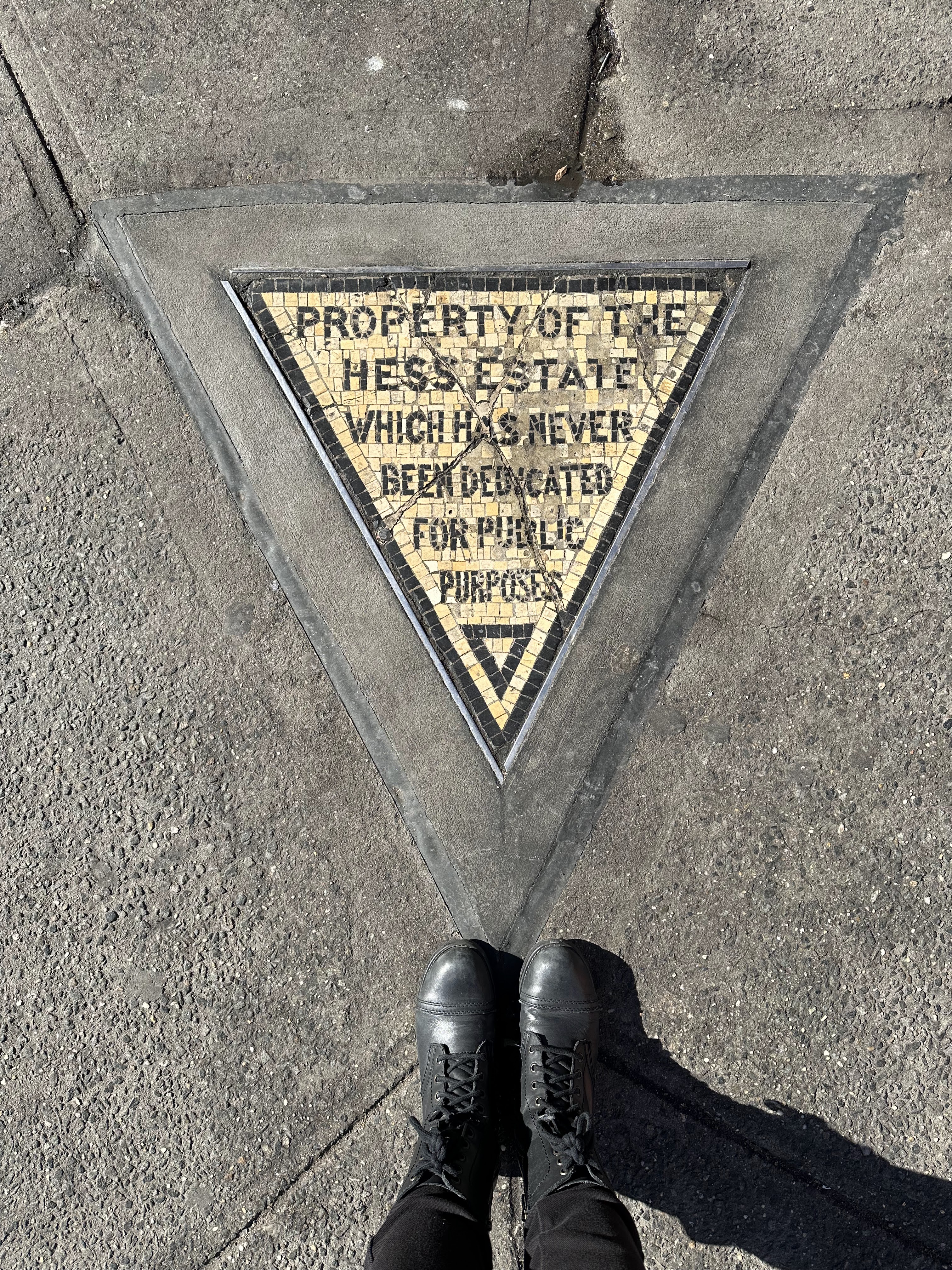
There’s been a tidal wave of heinous rent increases driving out neighborhood staples and I think it’s important to document these special places before they’re gone. Iconic Village Cigars, a West Village mainstay, was forced to shutter earlier this month, thanks to a rent dispute, after 100 years in business. Luckily for us preservationists, the shop is within the boundaries of the Greenwich Village Historic District, and any future tenant will be severely limited as to what they can change about the façade. The Hess Triangle, directly in front of the shop and my favorite quirk of rezoning and pettiness, is thankfully also protected. 

I've shifted mediums again - while my photos are still primarily shot on iPhone (now the 14 Pro) and Instax mini, I have also been steadily shooting more and more 35mm over the last couple of years. Because film is still not a cost-effective medium, I have had to be much more deliberate with what and how I make photographs, which has forced me to revisit the fundamentals of composition and pay close attention to light.

This project remains my driving creative force in this city, and as I said on the last Leap Day, it has pushed the bounds of my perspective. I can't wait to see where I am in another four years.


Village Cigars © Chelsea Pathiakis

Hess Triangle © Chelsea Pathiakis

Saturday, December 31, 2022

Reflections on Vivian Maier

One of my favorite activities is researching the work of photographers, alive or dead, whose images both validate something in my own work and who have tried things I’ve considered attempting, affirming my proclivities to experiment. When I find these things in a since-deceased artist, it feels like an endorsement from beyond the grave. These moments have an interesting way of sparking my inspiration jump-starting my drive to go out and shoot.

Vivian Maier’s work does all this and more. For example, I never want to photograph people until I revisit her street work. I always feel a wave of admiration when I come across one of her self-portraits in a convex security mirror – something I’ve shot dozens of times. She had an uncanny ability to capture striking images of daily life in interesting ways, and I strive to do the same.

I wonder how she would feel about the notoriety she’s received, and if she had ever considered developing the work herself. There are many unanswered questions, which I’m sure those who discovered her film [and have become wealthy in the exposition] and those who are “experts” [again, I scoff] have attempted to shed a light on, but no one really knows for sure what she thought or what she felt or why she photographed the way that she did. Why would someone so prolific hide her work? Could she simply not afford to have her film developed? I’m always one to dig for answers, but in the case of this singularly gifted artist, I hope the why and how always stay shrouded in mystery.

Some comparison shots, Maier on the left (black & white), mine on the right (color):


And a few more of hers:


Saturday, February 29, 2020

Roaming Four Years


Today marks four years since I started Roaming.

What began as a passion project and a catalyst for me to get out and start exploring my then-new-ish city has become the driving force behind all of my excursions. My eyes are always searching for shapes and shadows, open doorways and cracks in fences. I’ve trained myself to always look up: in a city with so many buildings decorated with so much history, it’s surprising how much time I spent just watching the sidewalk. Of course, it’s important to look down, too, especially with so many dogs in this town.

Over the course of the last four years I have shifted mediums. It began with my Nikon, and while the project is still primarily digital thanks to my iPhone, I started using my analog Instax mini in June 2019. The film project is an extension of Roaming but with a slightly different feel – and personality, according to my partner – that my digital images do not possess. I hope to keep experimenting with mediums for this portfolio, as there is no end-date in mind.

Roaming has changed my perspective. I have learned to look at the world around me through different eyes and to appreciate what others may not see, and what I know I may have overlooked had I not pushed myself out the door four years ago.

www.chelseapathiakis.com/roaming

Tuesday, June 11, 2019

Roaming London's Bookshops

At the beginning of this month, I spent a week in London. I’d been planning the trip since the fall, and in the midst of sketching out my itinerary, I made sure to pick out several bookshops to browse over the course of my stay. I rented a flat around the corner from the British Museum in the neighborhood of Holborn, in the borough of Camden, which put me within a four-block walking radius of several booksellers.

First was The London Review of Books shop, right on my corner, complete with its own tea shop and outdoor seating area, and home to a vast range of genres and book review quarterlies. (The London Review of Books is published fortnightly). I popped in three times over the course of the week.

In the opposite direction was the Atlantis Bookshop, an independent shop specializing in magic and the occult, tarot cards, incense, and various other related accoutrements. The shopkeeper, dressed in silky garb, with purple hair and a row of stars tattooed over her left eye, was having a conversation on the phone, and I happened to over hear a snippet: “If they had any sense at all they’d bask in your reflected glory and get on with it!”

Bookmarks, another shop in the immediate vicinity, specializes in left-leaning, social issue-focused, and occasionally radical texts. I noticed there were flyers posted in the windows for various social causes, and books by and for every racial minority, women’s issues, and so much more.

Venturing further out into London, I made a special trip west to Marylebone to find Daunt Books, perfectly catered to my taste for travel writing. If the collection alone wasn’t enough, the space itself boasts gorgeous oak architecture and an enormous vaulted skylight, making browsing their extensive selection of writing from and for every place imaginable even more cathartic with the sunlight streaming through. [Note: I experienced surprisingly good weather in London.]


On Sunday, in the midst of a trek around the East London neighborhoods of Bethnal Green, Shoreditch, Whitechapel, and Spitalfields, in the boroughs of Hackney and Tower Hamlets, I sought out and stumbled upon a few more shops. Making my way southwest from the Columbia Road Flower Market, I wandered down a neat little side street covered in murals and found Artwords Bookshop. With books and magazines on contemporary visual culture, fine art, graphic design, and fashion, I felt as though I discovered a treasure trove. I slowly perused their selection, pouring over books about keeping things fresh as a graphic designer and how “selfie culture” and the infiltration of photography into our everyday lives has reshaped our perception of the world around us.


Later, I found Brick Lane Bookshop, which was unfortunately much less interesting than I’d expected, amplified thanks to the crush of crowds swirling around the market tents up and down the street outside. Down the block, I checked out Rough Trade East’s selection of pop culture related titles, and a table of casual reader’s staples inside Old Spitalfields Market.

One of my last stops was the famous Notting Hill Book Shop. Never having seen the namesake movie myself (I know, I know), I at first found it odd that a small group of tourists were taking turns snapping selfies in front of the shop, but soon realized what I was I missing when I spied a wall of film paraphernalia inside. The selection was fairly ordinary, and I was soon pushed out of the way by a delivery service dropping off a dozen boxes of books.

Honorable Mentions:
The massive Forbidden Planet London Megastore had the most extensive sci-fi/fantasy/manga section I have ever witnessed. I even made a video of it for Frank so he could witness the magnitude.

The last stop on my Muggle’s Tour of London (of course I booked that!) was in the middle of Cecil Court, the inspiration for Diagon Alley. Famous on its own for book shops, I counted seven: a few antique and rare book sellers, a children’s shop with a poster of the illustrated version of Harry Potter right in the window, and Watkin’s Books, longtime seller of spell books, among other things.

Friday, April 12, 2019

McSorely's Wonderful Saloon


In sporadic moments of interest over the last year, I have been chipping away at Joseph Mitchell’s collection of New Yorker essays Up in The Old Hotel. The first in the anthology is McSorely’s Wonderful Saloon, Mitchell’s character study of McSorley's Old Ale House, the oldest Irish pub in New York City, and its patrons. This past weekend, I finally sought out the bar for myself and wrote of my experience:

April 6, 2019

Javier has been slinging two-for-two darks and lights here for twenty-five years. The two legendary brews, made in the basement during prohibition, supposedly taste exactly the same now, even after being passed around through half a dozen breweries in the city.

The group portrait on the wall behind me includes two men with notably fake mustaches; there are playing cards pinned to the ceiling. There are endless things to look at on the walls in here: The décor is exactly the same way Bill McSorley left it, the memorabilia bolted in place to preserve his father’s bar. Newspaper articles and awards and military caps and helmets and buttons above the center archway and Native American faces peering out from behind the bar and wishbones from decades of Thanksgiving turkeys hung over the center of the chandelier. Relics from the long, storied history of the Bowery.

I feel as though I stepped both back into the past and into an alternate universe. Time passed strangely as Frank and I sat there in the corner of the front room, ordering round after round and making friends with the visitors from San Diego and Los Angeles seated across from us; Mike and Chris, brothers. The cheese plate is comprised of thin slices of probably Monterrey Jack and a sleeve of saltine crackers. I like the continuous clink of glasses as the tenders of the rooms constantly collect empties and return them to the bar.

The woman with grey hair and dark eyebrows and a white collared shirt is forever cleaning glasses behind the counter and then setting them out to dry. She looks immaculate in such a time-worn establishment. Forty years ago, neither she nor I would have been allowed in here; now she’s permitted to work the counter and I’m permitted to drink and wait in line for the ladies’ room. The sawdust on the floor keeps me from slipping up after seven half-pints.