Tuesday, June 11, 2019

Roaming London's Bookshops

At the beginning of this month, I spent a week in London. I’d been planning the trip since the fall, and in the midst of sketching out my itinerary, I made sure to pick out several bookshops to browse over the course of my stay. I rented a flat around the corner from the British Museum in the neighborhood of Holborn, in the borough of Camden, which put me within a four-block walking radius of several booksellers.

First was The London Review of Books shop, right on my corner, complete with its own tea shop and outdoor seating area, and home to a vast range of genres and book review quarterlies. (The London Review of Books is published fortnightly). I popped in three times over the course of the week.

In the opposite direction was the Atlantis Bookshop, an independent shop specializing in magic and the occult, tarot cards, incense, and various other related accoutrements. The shopkeeper, dressed in silky garb, with purple hair and a row of stars tattooed over her left eye, was having a conversation on the phone, and I happened to over hear a snippet: “If they had any sense at all they’d bask in your reflected glory and get on with it!”

Bookmarks, another shop in the immediate vicinity, specializes in left-leaning, social issue-focused, and occasionally radical texts. I noticed there were flyers posted in the windows for various social causes, and books by and for every racial minority, women’s issues, and so much more.

Venturing further out into London, I made a special trip west to Marylebone to find Daunt Books, perfectly catered to my taste for travel writing. If the collection alone wasn’t enough, the space itself boasts gorgeous oak architecture and an enormous vaulted skylight, making browsing their extensive selection of writing from and for every place imaginable even more cathartic with the sunlight streaming through. [Note: I experienced surprisingly good weather in London.]


On Sunday, in the midst of a trek around the East London neighborhoods of Bethnal Green, Shoreditch, Whitechapel, and Spitalfields, in the boroughs of Hackney and Tower Hamlets, I sought out and stumbled upon a few more shops. Making my way southwest from the Columbia Road Flower Market, I wandered down a neat little side street covered in murals and found Artwords Bookshop. With books and magazines on contemporary visual culture, fine art, graphic design, and fashion, I felt as though I discovered a treasure trove. I slowly perused their selection, pouring over books about keeping things fresh as a graphic designer and how “selfie culture” and the infiltration of photography into our everyday lives has reshaped our perception of the world around us.


Later, I found Brick Lane Bookshop, which was unfortunately much less interesting than I’d expected, amplified thanks to the crush of crowds swirling around the market tents up and down the street outside. Down the block, I checked out Rough Trade East’s selection of pop culture related titles, and a table of casual reader’s staples inside Old Spitalfields Market.

One of my last stops was the famous Notting Hill Book Shop. Never having seen the namesake movie myself (I know, I know), I at first found it odd that a small group of tourists were taking turns snapping selfies in front of the shop, but soon realized what I was I missing when I spied a wall of film paraphernalia inside. The selection was fairly ordinary, and I was soon pushed out of the way by a delivery service dropping off a dozen boxes of books.

Honorable Mentions:
The massive Forbidden Planet London Megastore had the most extensive sci-fi/fantasy/manga section I have ever witnessed. I even made a video of it for Frank so he could witness the magnitude.

The last stop on my Muggle’s Tour of London (of course I booked that!) was in the middle of Cecil Court, the inspiration for Diagon Alley. Famous on its own for book shops, I counted seven: a few antique and rare book sellers, a children’s shop with a poster of the illustrated version of Harry Potter right in the window, and Watkin’s Books, longtime seller of spell books, among other things.

Friday, April 12, 2019

McSorely's Wonderful Saloon


In sporadic moments of interest over the last year, I have been chipping away at Joseph Mitchell’s collection of New Yorker essays Up in The Old Hotel. The first in the anthology is McSorely’s Wonderful Saloon, Mitchell’s character study of McSorley's Old Ale House, the oldest Irish pub in New York City, and its patrons. This past weekend, I finally sought out the bar for myself and wrote of my experience:

April 6, 2019

Javier has been slinging two-for-two darks and lights here for twenty-five years. The two legendary brews, made in the basement during prohibition, supposedly taste exactly the same now, even after being passed around through half a dozen breweries in the city.

The group portrait on the wall behind me includes two men with notably fake mustaches; there are playing cards pinned to the ceiling. There are endless things to look at on the walls in here: The décor is exactly the same way Bill McSorley left it, the memorabilia bolted in place to preserve his father’s bar. Newspaper articles and awards and military caps and helmets and buttons above the center archway and Native American faces peering out from behind the bar and wishbones from decades of Thanksgiving turkeys hung over the center of the chandelier. Relics from the long, storied history of the Bowery.

I feel as though I stepped both back into the past and into an alternate universe. Time passed strangely as Frank and I sat there in the corner of the front room, ordering round after round and making friends with the visitors from San Diego and Los Angeles seated across from us; Mike and Chris, brothers. The cheese plate is comprised of thin slices of probably Monterrey Jack and a sleeve of saltine crackers. I like the continuous clink of glasses as the tenders of the rooms constantly collect empties and return them to the bar.

The woman with grey hair and dark eyebrows and a white collared shirt is forever cleaning glasses behind the counter and then setting them out to dry. She looks immaculate in such a time-worn establishment. Forty years ago, neither she nor I would have been allowed in here; now she’s permitted to work the counter and I’m permitted to drink and wait in line for the ladies’ room. The sawdust on the floor keeps me from slipping up after seven half-pints.


Wednesday, February 20, 2019

Andy Warhol: By Hand

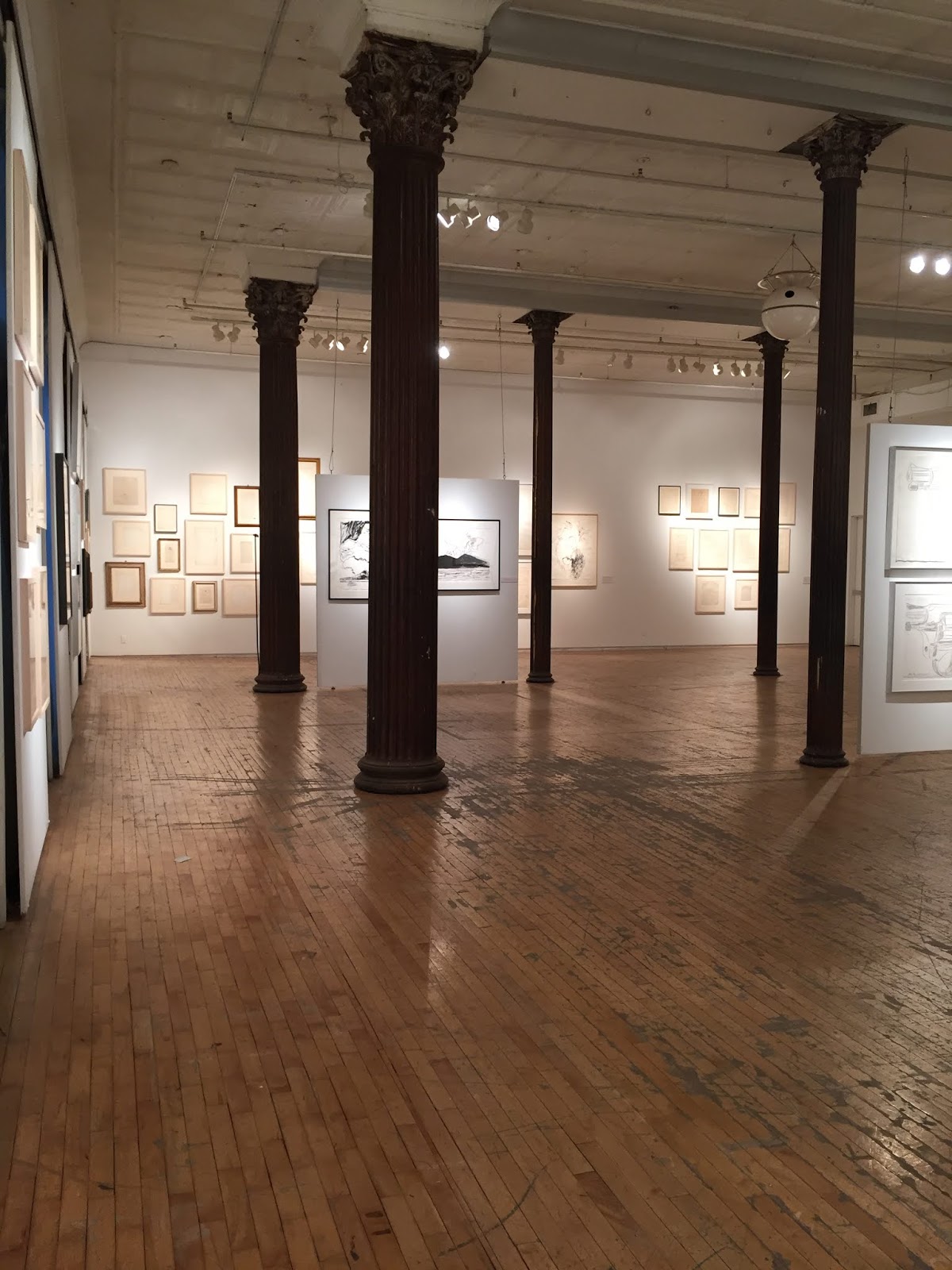
On Sunday, January 27, I attended the opening of New York Academy of Art’s Andy Warhol: By Hand. I was surprised and delighted to find that I was the only patron in the main gallery of this tiny, out-of-the-way art school in Tribeca – of which Warhol was a founding board member – and I relished in the absolute silence as I took my time absorbing each and every drawing on display. I have never before, and likely will never again, experience an empty gallery in New York City.

I have paid Andy Warhol a great deal of attention over the course of my life as an artist. I have written research papers and book reports about him, read about his life, work, and social scene (and hangers on) in New York, and always keep an eye on the Decker building in Union Square, the last site of his Factory. I have watched documentaries, attended exhibitions, and carry his more famous works around in the form of several canvas tote bags. You could say I’m a fan; inexplicably drawn to anything Warhol.

However, in all my research, his drawings, some of his earliest works, rarely come up. The exhibition featured still lifes; sketches of hands, feet, and genitalia; portraits; landscapes from travels; animals; and various commissioned works for advertisements. Apart from the artist’s self-portrait, all of these drawings were new to me. The current Warhol retrospective at the Whitney (for which NYAA’s show was planned to compliment) also features some lesser-known works, but not to the magnitude of this much smaller exhibition.


Monday, February 11, I attended NYAA’s panel discussion hosted by David Kratz, President of the Academy, speaking with Vincent Fremont, curator of the exhibition and former executive studio manager of the Factory, and John Giorno, performance artist, former Warhol model, and star of Warhol’s film “Sleep.”

From left: NYAA President David Kratz, Vincent Fremont, and John Giorno 

 During the discussion, I gained an insight into Andy Warhol that only those who had known him could have provided:

Vincent met Andy at Woodstock in 1969. He and a group of friends came to the city soon after and stayed at the Chelsea Hotel. He interviewed with Andy the next day and was appointed executive studio manager of the Factory. Vincent relayed that Andy was a different person to everyone he knew, with many different layers, and that Andy was an “energy gatherer,” exuding a magnetic pull that drew so many different types of people to him. Accessible to the press, Andy understood commerce but never “sold out,” making the claim that “business is the best art.” Andy preferred to listen and record others speaking rather than speaking himself. Vincent met Andy after Valerie Solanas’ assassination attempt and noted that this event was catastrophic to the artist, affecting Andy psychologically and stifling his work for a long time afterward: he no longer went to Max’s Kansas City, a favorite haunt; he photographed his scarred body, over which he wore a corset for the rest of his life; and as death was an abstraction to Andy, the trauma caused confusion of what was real and what was not.

As for Andy’s drawings, Vincent explained that some of the pieces, especially those done while travelling the world were created as visual journals. A small heart drawn on a portrait was an indication that Andy cared for the person he was illustrating, and he referred to nude portraits as “landscapes,” a fact I really enjoy. A majority of the drawings on display were done from life, with the exception of several illustrations of children copied from photographs in LIFE Magazine. In Vincent’s words, Andy looked at the world more differently than anyone else.

John met Andy in 1962, and described the artist as kind, gentle, simple, and brilliant; a force in the art world because the things he was doing were being done for the first time. John enjoyed Andy’s mind: any time Andy said something interesting, John would write it down and make up a question for it, like a backward interview, and called the series, “Andy Warhol Interviewed by a Poet.” John, a gay rights activist, mentioned that the abstract art scene in the 1950’s was extremely homophobic, and Andy was rejected from the Tanger gallery for being gay, but as Vincent said, Andy soon became a force in the gay art scene. John believes the self-portrait on display, made toward the end of Andy’s life, may have been precognition, and anticipation of his own death, and that the hair of his legendary wig sticking up may be symbolic of Andy’s belief that the “best way to leave your body is through the top of your head.”

John said, “Andy’s art is autobiographical and a reflection of his mind,” and also, “Artists talk to you, but they’re really talking to themselves about what they’re [creating].” I am always hungry for new insights and perspectives, especially if they can impact any preconceived notions I’ve developed. Listening to these two men expound upon a man both so public yet shrouded in mystery, explaining not only his work but his carefully curated self-image, was a great privilege.


© 2019 The Andy Warhol Foundation for the Visual Arts, Inc. / Licensed by Artists Rights Society (ARS), New York
Artwork courtesy Private Collection

Wednesday, November 21, 2018

Duane Michals - Empty New York


On Thursday, November 8, I went to hear photographer Duane Michals speak at 192 Books on 10th Avenue about his new book, Empty New York. Michals began making photographs in 1963-64 after falling deeply in love with Eugène Atget’s documentation of the streets and architecture of Paris. Atget was relatively unknown at the time; most of his work was published posthumously by Berenice Abbott. Michals wanted to see the environment of New York City without people. He said that when you peer into a room with even one person inside, you see that person, not the room itself. He began photographing early in the morning and pressed his camera lens against the windows of empty shops and restaurants. Michals said he saw these places like stage sets, waiting for the cast to arrive. Everything is a performance: a barber in his barbershop is doing the barbershop act, the bookseller in the bookshop is doing the bookshop act. Little dramas.

Going off on so many tangents throughout his talk, I made note of some of Michals’ most interesting points. He learned everything he knows about photography on the job. He said going to school for photography is a waste of time, and that anyone interested in pursing the art should just “go out on the street and take pictures.” He believes that if you do attend university, you should leave school asking more questions than when you arrived. This particular point resonated with me, because school tends to drain artists of their creativity when we’re forced to learn and follow so many rules – something I experienced – and for most of us, the only question we were asking when we graduated was “what the hell am I doing?” (I’ve been incredibly lucky to have overcome that.) Michals said that those constraints stopper creativity and it’s much harder to unlearn the rules than it is to learn them in the first place.

He hates MoMA because he thinks of it like a factory in both design and content, which I found ironic due to his connection to Andy Warhol. I wrote a piece on Michals in August of 2016, detailing my introduction to his work and about finding an issue of GROUND Mag with his photograph of Andy Warhol covering his face with his hands, and the subsequent cover story. While Michals was speaking, he brought up Warhol, and described him as “one of the most boring people” he’s ever met. I couldn’t help but laugh, given my attraction to anything Warhol-related, which is initially what lead me to discover Michals’ connection to him.

He mentioned Ralph Eugene Meatyard, a photographer whose work has always made me uncomfortable, and said, “We should not be surprised that an optician became a photographic seer.” He also had a lot to say about portraiture, declaring, “Most portraits are lies,” and, “The biggest con men are the big smilers.” This reminded me of what he said in the GROUND Mag article about selfies, and how much us heading in that direction photographically troubles him.

He called himself the “antichrist photographer,” because of his love for digital, even throwing out, “Fuck film! I love digital!” He tore down everything a purist photographer would believe, though at 86 years old with a massive body of work, it seems he’s earned the right to be called an authority on the subject and no longer worry about the purity of the art form.

When he was finished speaking, those of us who wanted our copies of the monograph signed queued up. I was first in line and had a chance to tell him that the quote I loved from his article in GROUND Mag has been hanging on my mirror in my apartment for the last four years. He asked me to recite the quote, and actually spoke aloud about that idea momentarily.
He signed my book: “Hello Chelsea…. Goodbye. Duane Michals
”


Sunday, July 1, 2018

Searching For Soul


Last July, Jeremiah Moss's book 'Vanishing New York: How A Great City Lost Its Soul' hit bookstores. Last Thursday, I attended a panel at the Museum of the City of New York, where Moss and three others had a discussion about the impact of hyper-gentrification on the city. It was thrilling to be in a room full of other people as passionate about this subject as I am, as I'm the only person across all of my groups of friends who cares about this at all.

I read (almost) exclusively historical non-fiction about the city these days, and the list of books I've devoured is growing. This is a subject I've been passionate about for a couple of years, and Moss's book helped to clarify exactly what is going on in New York; from the High Line's massive impact on the west side, to mail-order services killing the local shops, to the "glass monstrosities" built on the rubble of entire city blocks, razed for the elite to move in.

During the panel, Moss elaborated on a point he made in the book: the people who are moving into the city now, into areas steeped in historical and cultural significance, don't have a shred of nostalgia for the neighborhood in which they've chosen to reside. For example, folks my age move into the East Village on the wings of trust funds, spend $4,000/month on studio apartments in glass boxes, and turn a blind, ignorant eye to how that section of the city came to be trendy in the first place. Moss said, "Nostalgia gets a bad rap in our current culture," and I couldn't agree more: that's exactly why the soul of this city is slipping away. In this age of instant-gratification and Instagram stories, most millennials won't care if a historic corner store is bulldozed, as long as a shiny new restaurant rises in its place.

However, after the four speakers on the panel had brought their conversation to a close, and opened up a Q & A with the [at capacity] audience, one person made a comment that has stuck with me. Susan Mayer is a 74-year old graphic design teacher who moved into a tenement building on the Lower East Side in her late teens/early twenties. It was the kind of space where the bathtub was in the kitchen, a cubicle in the corner that looked like a phone booth held the toilet, and two faux fireplaces did nothing to heat the $65/month apartment, and it was the kind of place where the whole building was a community, everyone knew their neighbors, and people would stop to say hello.
Susan said, "The soul of the city resides in the lived-in spaces."


From the outside, it's getting harder to see the remains of the old New York, the cultural beacons in the form of bars, restaurants, and event spaces that were the hangouts of so many influential artists, writers, and taste-makers of past eras. I make it my business when reading about any particular area of the city to frequent the neighborhood as often as possible, and to look for remnants of the past. Right now, I'm reading John Strausbaugh's 'The Village: 400 Years of Beats and Bohemians, Radicals and Rogues, a History of Greenwich Village,' and I've been hopping off the train at West 4th with my camera every chance I get. My Roaming project has always been about New York from my perspective, and there's been a subconscious shift toward the more historically significant areas within the last year. It's much more difficult to access those lived-in spaces, but I'm hopeful they still exist.

Tuesday, December 26, 2017

Stephen Shore: Retrospective

On November 19, 2017, the Stephen Shore Retrospective opened to the public at the Museum of Modern Art in New York City.

Mr. Shore's unique perspective has been a source of inspiration since college, when I was handed his "Uncommon Places" by my professor, after a successful critique of a series I'd been working on. Since that day, he's become my favorite photographer and his work has had a profound influence on my own. Seeing his massive body of work renewed my enthusiasm, and reminded me just how much I love documenting the world in my view.


Two weeks later, the Strand Bookstore was holding a book signing for the monograph from the retrospective. I was so excited to meet Mr. Shore and have him sign my copy that I could barely contain myself. I never know what to say when meeting anyone remotely noteworthy, and Mr. Shore holds idol status for me. When it was my turn, I managed to utter a compliment and asked for a photo with him.


Thursday, September 7, 2017

Governors Island

When my parents visited in mid-July, we made the long train ride and surprisingly quick ferry voyage to Governors Island, New York City’s little oasis. As it turns out, the island is my little oasis as well.

Manhattan Skyline from the Governors Island Ferry - Chelsea Pathiakis

We spent a few hours walking around the island. My favorite area is Colonel’s Row – eight very old brick buildings once home to military officers and currently used as studio space for local artists. Since there was no one telling me I couldn’t, I spent some time in two of the houses photographing the empty upper floors. This was the first time I felt photographically inspired in months. The sweltering, stagnant heat inside normally would have been unbearable but my mind was whirring and I barely noticed. 
Chelsea Pathiakis

I returned two weeks later on my own to discover we had missed an entire half of the island. I found Nolan Park and the Admiral’s House, where I camped out in a rocking chair on the porch for a couple of hours writing. It was a blissful day of self-reflection.

Chelsea Pathiakis

This past weekend I took the ferry with a friend, from Long Island City all the way down the coast of Brooklyn, to the island once more. The ferry ride gave me a chance to view Manhattan and Brooklyn from a distinct perspective, and I have added a few places to my list of areas to see. It was a gorgeous, cool Labor Day weekend and we laid in the grass in front of Colonel’s Row. The annual art fair was going on, with some unusual pieces on display. 

Chelsea Pathiakis

Art Fair Installation - Chelsea Pathiakis

I hope to return in late October to see the Night of 1,000 Jack-O’-Lanterns.