Friday, August 30, 2024

Appreciation: Andy Warhol

Andy Warhol, Liz, 1964

So much can been said about Andy Warhol and his impact and influence on modern art and popular culture. He coined the term “pop,” first established the “fifteen minutes of fame” phenomenon, and was responsible for a major shift in the world of commercial art. I have been enamored with his work and the man himself since high school, even writing my first major research paper on his THE Philosophy of Andy Warhol (From A to B and Back Again). I continued to focus on him in art school, and since moving to New York have had the good fortune to meet three separate photographers who spent time in his orbit: Stephen Shore (Factory: Andy Warhol), Larry Fink (Fink on Warhol: New York Photographs of the 1960s), and Duane Michals (who, I mentioned in a 2018 post, called Warhol one of the most boring people he’s ever met).

I have attended numerous gallery shows of his work, including the major retrospective at the Whitney Museum in 2018-2019. I have totes with his work on them and a wear a button of an early self-portrait of his on my denim jacket. You could say I’m a big fan.

I’ve been reading This Must Be the Place by Jesse Rifkin, which mentions Warhol’s presence and influence in the back room at Max’s Kansas City. The artist has been front of mind recently, and I thought he deserved an updated spot on this blog.

Stephen Shore, Andy Warhol, The Factory, NYC, 1965-67

Tuesday, July 30, 2024

In Focus: Berenice Abbott, Changing New York, and Erasure

In a little over a month, I will hit a milestone: ten years in New York City. I’ve been reflecting on how much I have changed in that time, and how much the city around me has changed over the last decade. We are both unrecognizable.

When I moved to Long Island City/Astoria, there was a single tall building in Queens Plaza – the former Citibank building. Now there are dozens of tall glass boxes, many sitting empty or at meager capacity, built in an upsurge of interest in the area when A*azon was planning to build their headquarters in the neighborhood, and left desolate after their reconsideration (a nice way of saying they were met with vehement vitriol from politicians and preservationists who understood the irreparable damage their residency would inflict on the working-class neighborhood they planned to occupy). The area around these towers has drastically changed since then: gone are the small manufacturing warehouses, now the streets are home to chain big-box stores and trendy groceries.

Ten years ago, I was a fresh suburban transplant trying to figure out how to live my life in a place that could not be more different than where I came from. The preservation and anti-gentrification consciousness came on slowly, but I knew from day one that I would never and could never expect the city to conform to me (why would I?), and I set out to learn everything I could about its history. It started with a fascination of the subway: how it was built, what areas it served, and how it changed the landscape of the city. Then came the dozens of neighborhood-specific, historical non-fiction books I devoured (and continue to), like The Bowery by Stephen Paul Devillo, The Village by John Strausbaugh, St. Mark’s is Dead by Ada Calhoun, Inside the Dream Palace by Sherill Tippins, and many more. I was fascinated by the stories of earlier versions of these places while at the same time mourning the loss of key parts of the city’s cultural history. Then came Vanishing New York by Jeremiah Moss, and everything clicked into place. Here was someone deeply aware of the city’s politician’s and landlord’s megalomaniacal and unyielding commitment to hyper-gentrification, who was keeping a record of the losses (some of which I personally experienced), documenting not only the erasure of neighborhood staples but the erasure of neighborhood culture. Moss brought into focus for me how homogenized the city was becoming, and I’ve been watching it happen (powerlessly, furiously) in real time ever since.

In the same way that Eugene Atget documented Paris before it was forever changed, Berenice Abbott worked in the same spirit of preservation in New York. She began her photographic career as Man Ray’s studio assistant in Paris, became a photographer in her own right, met and photographed Eugene Atget, then acquired a large portion of his work after his death. She was the biggest promoter of Atget’s photography, making it available to the public, creating exhibitions. Inspired by Atget’s style and a visit to New York, Abbott spent six years working independently to document the city, then was hired by the Federal Art Project (FAP) in 1935, receiving funding to continue her Changing New York project through the end of the decade.

I attended Berenice Abbott’s New York Album 1929 exhibit at the Met last year. I was infused with a rush of inspiration to continue documenting the city the way I have been since 2016 and was frustrated that I was only then introduced to the work of an artist who’d always been in my periphery but that I had never looked further into. Here was someone who did what I’ve been doing, eighty years prior.

Middle East Side, Union Square West, Nos. 31-41

In my research of Abbott’s work, I found at least two examples of buildings or entire neighborhoods that were razed to make way for public housing projects. The Smith Houses in Two Bridges sits on what was once a bustling network of streets full of working-class families and businesses. My clue to this was the following photograph made on the corner of Oak and New Chambers Streets, both of which no longer exist. The entire neighborhood was razed in 1950-1953, erasing a part of the Lower East Side right off the map.

Lower East Side, Oak and New Chambers Street

Less troubling, but no less a loss are the several images she made below and above the elevated train lines. The trestles were infamously filthy, loud, and a blight to the surrounding streets. This image made at 250 Pearl Street of the Second and Third Avenue El is striking due to the juxtaposition of the massive steel structure and the tiny silhouettes of two men on the street below.

Wall Street, "El," Second and Third Avenue Lines, 250 Pearl Street

Abbott’s contribution to the world of documentary and street photography is irrefutable. Like Atget before her, Abbott made a record of a now-unrecognizable city, preserved evermore in silver gelatin.
We who are passionate about the preservation of this city are lucky to have such a thorough and detailed capsule of the 1930s.

Greenwich Village, Broome Street, Nos. 512-514

Sunday, June 23, 2024

Vivian Maier: Unseen Work

Self Portrait, New York, NY, 1953

This week I visited Fotografiska to see Vivian Maier: Unseen Work.

I’ve made one previous post about this special artist, comparing my own work to hers and reflecting on the myriad inspirations that arise when I spend time with her photographs. I rarely feel emboldened to make pictures of people (in truth I feel more confident in doing so when abroad, perhaps because the language barrier provides a buffer), but again, after seeing the work on view, I’m considering trying my hand at candid portraiture in my own city.

That said, there is something in Maier’s photographs that I feel I won’t readily attain: character. The bulk of my work is centered on documenting what remains of past generations of this city amidst a depressing homogenization of buildings (see: oppressive glass boxes) and it’s uncommon to see well- or interestingly-dressed people out and about (see: athleisure). I’m not saying it can’t be done, but achieving the same quality Maier did in her portraiture might not be within the realm of possibility for a photographer of my predilection in a city this hyper-gentrified.

This was the second Maier exhibition I have had the pleasure of attending. The first was Vivian Maier: The Color Work at Howard Greenberg Gallery in November 2018. While she predominantly shot monochrome, Maier’s color work is exquisite. At Unseen Work, there were a select few color images, printed by the photographer, that have lost their luster to the ravages of time; these were not part of The Color Work show. I overheard a French woman, speaking to another attendee while viewing these images, remark that Maier’s work loses quality when in color. I had to stop and tell her about The Color Work, of which she was not aware, which lead to an interesting discussion about Maier and the difficulty of finding great photo exhibitions in New York City. I could only partially agree: I have seen some truly incredible gallery shows, exhibits, and retrospectives in my time here, but they do seem less frequent these days. Shieli, the woman with whom I was speaking, then told me that in Paris for the entire month of October, all of the art galleries have photography on view. Apparently this is a yearly tradition, and one that I am now eager to experience.

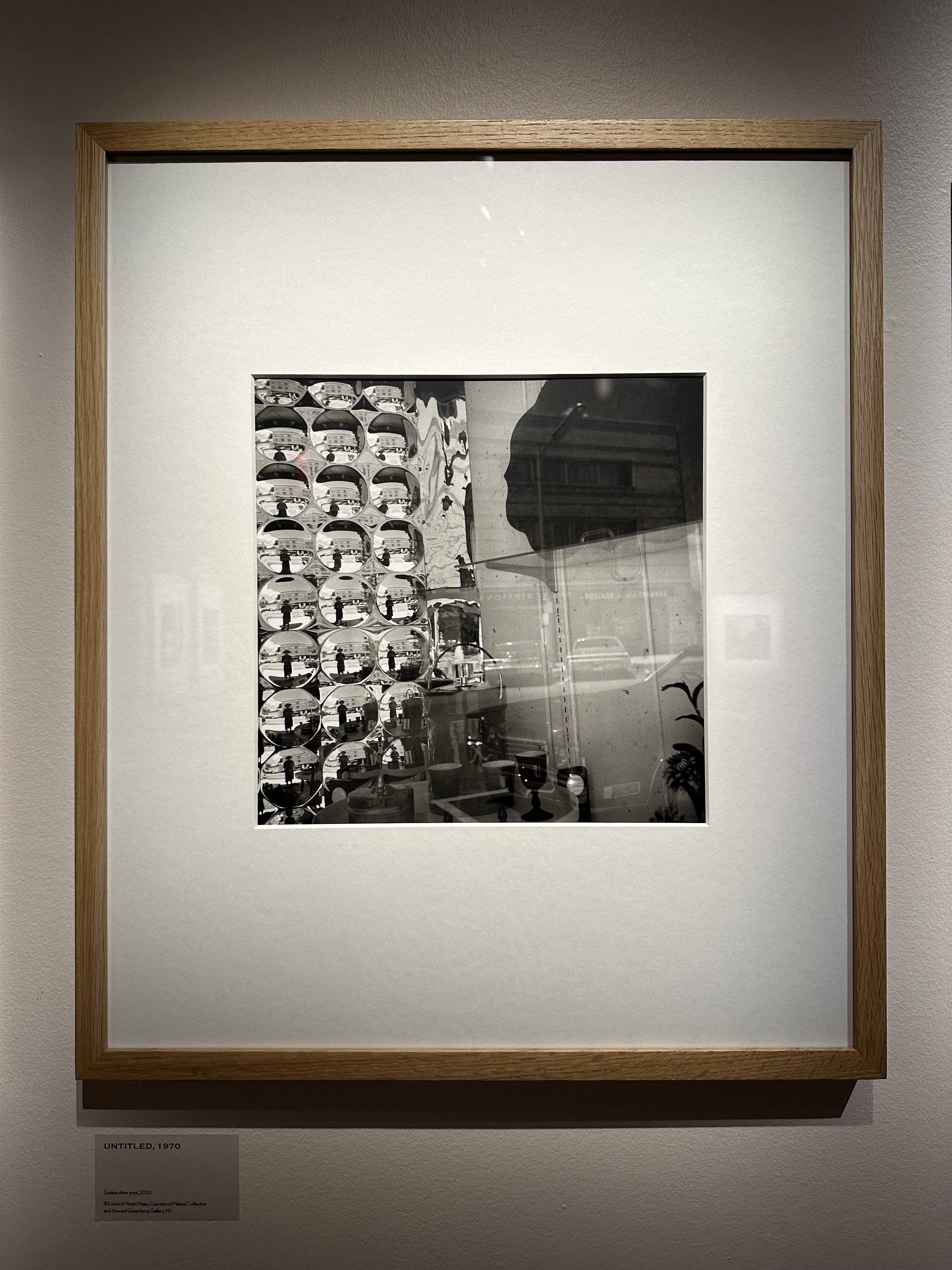
One of my favorite things about Maier's work is her framing. Whether it be self portraiture in various reflective surfaces or of other people going about their business, she was a master of finding interesting ways to frame her subjects. Below are a selection of images from the exhibition I found myself lingering over that had this quality.


Thursday, May 30, 2024

Shhh

I’ve become obsessed with silence.
Searching for it, reveling in it when I do manage to find it, and learning to appreciate the moments where my world is blissfully, totally quiet.

This may be a reaction from living in a very noisy city for nearly a decade, as well as the wisdom that comes from being in my mid-thirties and realizing being at peace is favorable to chaos. I prefer the tinnitus ringing brought forth by the use of ear plugs over the early morning cooing of sexually active pigeons in my airshaft. I prefer the relative stillness of my cozy apartment over the deafening roar of other humans and various vehicles I confront by stepping out the front door. Not to say I never leave, but to venture out takes more mental preparation these days. This fascination with quiet lead me to look for traces of it in the work of some of my favorite photographers. 

Stephen Shore’s cross-country road trip photos in Uncommon Places came to mind first; the calm, occasionally desolate vistas he captured in the mid-70’s always instill a sense of quiescence.

U.S. 97, South of Klamath Falls, Oregon, July 21, 1973

Bellevue, Alberta, August 21, 1974


Eugene Atget’s Paris work, taken in the early mornings of the late 19th and early 20th centuries, and almost totally devoid of other people, imply a silence one could only dream of now.

Église Saint-Médard, Paris, 1900

Boulevard de Bonne-Nouvelle, Paris, 1926


Duane Michals' Empty New York conveys similar, as he modeled his process for this work after Atget’s efforts across the pond. Taking to the streets before dawn during 1964-65, he captured a nearly unrecognizable city: empty, motionless, quiet. [I made a post about this work and Michals' ethos in 2018, it can be viewed here]

Untitled, New York, 1964-65


Untitled, New York, 1964-65


Francesca Woodman’s self portraits, while somber and sometimes haunting, are silent by design. Most of her work has this quality, but none more so than the typically untitled work created in the dilapidated Providence apartment she occupied as home and studio during her time at The Rhode Island School of Design in the mid-1970’s.

House #3, Providence, Rhode Island, 1976

House #4, Providence, Rhode Island, 1976

Thursday, February 29, 2024

Roaming Eight Years

I started this project on Leap Day 2016 because there is something quasi-poetic about a series regarding space and time having its anniversary on a day that feels like it’s outside of space and time.

The project has always been about memory, both mine and the collective memory of this city. I’ve been thinking about the way I learn, and repetition is one of the best ways for me to internalize new information and keep present not-so-recent findings. With that in mind, I made my roam today about revisiting places I’ve photographed before in the spirit of preservation and remembrance.

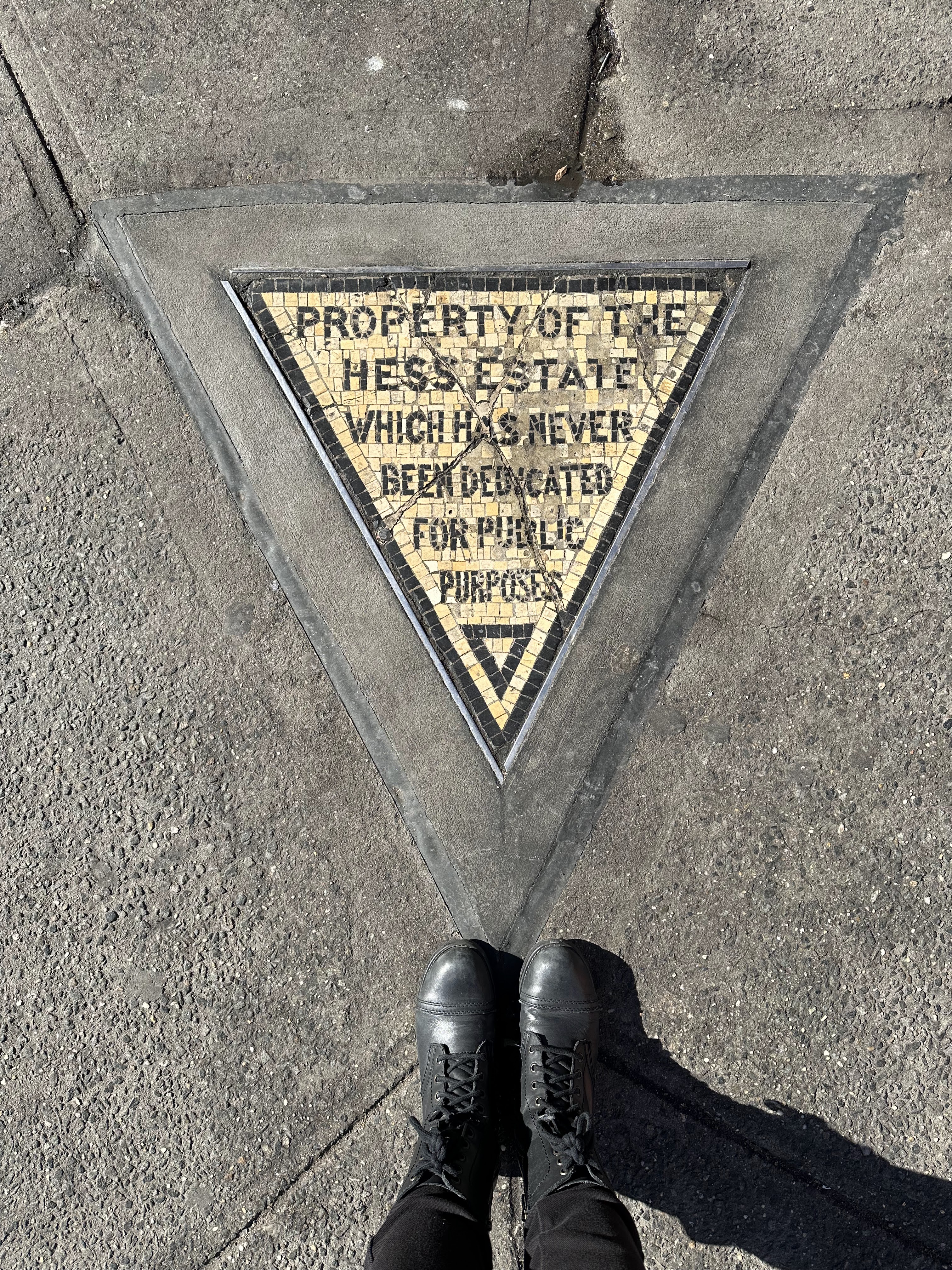
There’s been a tidal wave of heinous rent increases driving out neighborhood staples and I think it’s important to document these special places before they’re gone. Iconic Village Cigars, a West Village mainstay, was forced to shutter earlier this month, thanks to a rent dispute, after 100 years in business. Luckily for us preservationists, the shop is within the boundaries of the Greenwich Village Historic District, and any future tenant will be severely limited as to what they can change about the façade. The Hess Triangle, directly in front of the shop and my favorite quirk of rezoning and pettiness, is thankfully also protected. 

I've shifted mediums again - while my photos are still primarily shot on iPhone (now the 14 Pro) and Instax mini, I have also been steadily shooting more and more 35mm over the last couple of years. Because film is still not a cost-effective medium, I have had to be much more deliberate with what and how I make photographs, which has forced me to revisit the fundamentals of composition and pay close attention to light.

This project remains my driving creative force in this city, and as I said on the last Leap Day, it has pushed the bounds of my perspective. I can't wait to see where I am in another four years.


Village Cigars © Chelsea Pathiakis

Hess Triangle © Chelsea Pathiakis

Saturday, December 31, 2022

Reflections on Vivian Maier

One of my favorite activities is researching the work of photographers, alive or dead, whose images both validate something in my own work and who have tried things I’ve considered attempting, affirming my proclivities to experiment. When I find these things in a since-deceased artist, it feels like an endorsement from beyond the grave. These moments have an interesting way of sparking my inspiration jump-starting my drive to go out and shoot.

Vivian Maier’s work does all this and more. For example, I never want to photograph people until I revisit her street work. I always feel a wave of admiration when I come across one of her self-portraits in a convex security mirror – something I’ve shot dozens of times. She had an uncanny ability to capture striking images of daily life in interesting ways, and I strive to do the same.

I wonder how she would feel about the notoriety she’s received, and if she had ever considered developing the work herself. There are many unanswered questions, which I’m sure those who discovered her film [and have become wealthy in the exposition] and those who are “experts” [again, I scoff] have attempted to shed a light on, but no one really knows for sure what she thought or what she felt or why she photographed the way that she did. Why would someone so prolific hide her work? Could she simply not afford to have her film developed? I’m always one to dig for answers, but in the case of this singularly gifted artist, I hope the why and how always stay shrouded in mystery.

Some comparison shots, Maier on the left (black & white), mine on the right (color):


And a few more of hers:


Saturday, February 29, 2020

Roaming Four Years


Today marks four years since I started Roaming.

What began as a passion project and a catalyst for me to get out and start exploring my then-new-ish city has become the driving force behind all of my excursions. My eyes are always searching for shapes and shadows, open doorways and cracks in fences. I’ve trained myself to always look up: in a city with so many buildings decorated with so much history, it’s surprising how much time I spent just watching the sidewalk. Of course, it’s important to look down, too, especially with so many dogs in this town.

Over the course of the last four years I have shifted mediums. It began with my Nikon, and while the project is still primarily digital thanks to my iPhone, I started using my analog Instax mini in June 2019. The film project is an extension of Roaming but with a slightly different feel – and personality, according to my partner – that my digital images do not possess. I hope to keep experimenting with mediums for this portfolio, as there is no end-date in mind.

Roaming has changed my perspective. I have learned to look at the world around me through different eyes and to appreciate what others may not see, and what I know I may have overlooked had I not pushed myself out the door four years ago.

www.chelseapathiakis.com/roaming